EU-bashing requests for EU to act on migration won’t work

Trying to push for a new EU policy whilst at the same time using the sort of EU-bashing language that creates anti-European sentiment in the first place may work in the short term but it will backfire in the long term. This is particularly true in the UK context (and may be less so in other countries), and British activists need to watch their language.

Last week I was concerned about the language used by Save the Children in their very important campaign, which I support. Today, I have similar concerns about the language used by anti-xenophobia groups, which I also think are doing amazingly good work – particularly the “I’m an immigrant” poster campaign. But precisely because they are so great, they need to watch their language on the EU if they want to have an impact. In particular, they should avoid saying that thousands dying in the Mediterranean are due to something that has been “imposed by the European Union”. This is what they do in a leaflet calling for a demo this weekend in front of the EU offices in London.

Screen Shot 2015-04-20 at 10.06.00

Of course, I don’t mean to say the European Commission is devoid of all responsibilities when it comes to “Fortress Europe” – i.e. the de facto impossibility for migrants to come to Europe from outside other than by risking their lives. Of course not. But it is important to remember that the European Commission does not IMPOSE anything on member states. The idea of things being imposed is classic Europhobic misleading language, and it won’t help the anti-xenophobia cause to adopt it. The Commission makes proposals, generally designed in ways that are perceived to be realistically able to survive the scrutiny of member states and the European Parliament. These are the ultimate decision makers. If the proposals that are being made now by the Commission on migration are woefully inadequate – and it seems they are – it is most likely because there is a fear that many governments in the grip of right wing, xenophobic rhetoric will not be able to support something better.

So I am all for protesting in front of EU offices in London to show the need for EU action, and the European Commission also needs to feel the pressure. But activists may also want to consider a more urgent need to protest in front of the Daily Mail, UKIP and even more mainstream political parties that are using misleading information (including on the EU) and xenophobic language and on a daily basis. This is the real background problem that needs solving, without which no EU level action supported by the UK will ever be possible.

British activists: mind your language on the EU

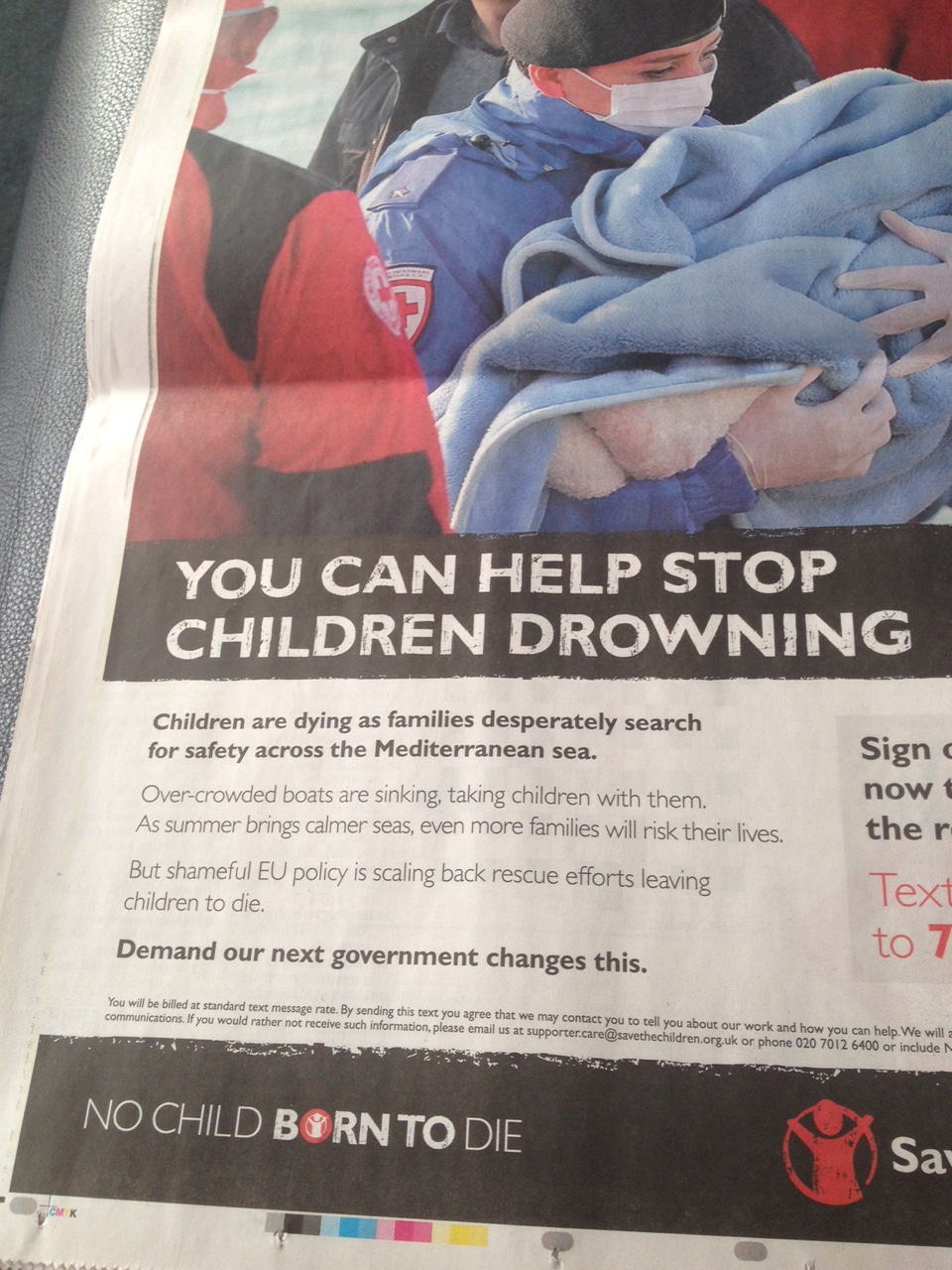
I am very pleased to see that Save the Children has launched a petition to restart rescue operations in the Mediterranean. I’ve just signed it, and encourage others to do so. I am grateful the organisation is working on this. I do however have a problem with the wording of the petition and the newspaper ad – and please, nothing personal against the lovely people that have been working hard on this campaign, as this is a broader issue that goes well beyond Save the Children.

I just wish they didn’t use the wording “shameful EU policy”. There isn’t a proper EU policy in place on this. There is currently no legal way for refugees and migrants to come to the EU, which is why they risk their lives on boats. And the reason there is no EU policy, is because governments have so far refused to agree one. It is governments which have stopped rescue operations – including the UK which specifically stated they could provide a “pull factor”. 

IMG_4038

So the petition should read “shameful lack of leadership by EU governments” instead.

Why is a seemingly small detail so important?

In his excellent new book about Brexit, Denis MacShane says that one of the reasons why Britain is at high risk of leaving the EU is not just because of the anti-EU press coverage, but also because of the silence of pro-Europeans. He is talking about the press in particular. But there is – in my opinion – also another major constituency that needs to change what it is doing: the great and glorious UK civil society and campaign groups.

These groups often want joint EU-level action, from development or humanitarian aid to climate change policy, but will very rarely talk about it explicitly. They will happily campaign against something the EU is doing – the TTIP for example – but you will hardly ever hear any of their senior level people say something positive about the EU more generally. Many organisations prefer to steer clear from what is considered a very toxic issue in UK politics (or maybe they simply know the press is not interested in positive EU stories, which goes back to MacShane’s point). When these organisations do touch on EU issues in public facing campaigns, they will often use the sort of unhelpful language that I discussed above.

Why is it unhelpful? Trying to push for a new EU policy whilst at the same time using the sort of EU-bashing language that creates anti-European sentiment in the first place may work in the short term, but will backfire in the long term. The Lobbying Act puts a lot of constraints on what charities can say in the run up to the election so I wonder whether blaming “EU policy” may be the easy way to get people’s attention without blaming any political party.

Yet this is a long-standing problem. With very few exceptions that I know of – Friends of the Earth’s Mike ChildsTony Juniper and Ben Jackson of Bond among them – UK civil society leaders are generally very quiet on Europe. And by doing so they are ultimately making it more likely that the UK would vote to leave in a referendum. Leaving the pro European camp in the hands of business lobbies with untenable positions (constantly bashing EU regulations in the press and then balking at the idea people may want to actually leave the block) is not going to work. Those who work on issues that benefit from international cooperation need to speak up.

I am not suggesting UK NGOs should start systematically campaigning in favour of the EU but if there is a referendum they may want to do some thinking on the implications of a Brexit for their work. They often have excellent EU policy experts inside the organisations which may be able to help. And at the very least they could start to watch their language, to avoid pandering – perhaps unwittingly – to anti-European sentiments.

So you want to be a columnist?

I attended a Guardian newspaper Masterclass last weekend and got to listen to an impressive line-up of some the newspaper’s best known columnists. Most participants I spoke to didn’t necessarily aim to become famous writers, although the speakers appeared to assume so. “All bloggers really want is to have a newspaper column” one of them offered. I have my doubts about it. Many were simply looking for tips on how to write better for blogs or lesser known publications, and generally to hear more about how the press works. We got what we wanted, and in a nutshell, here are just a few things I learnt:

1) If you consider yourself a writer, you have to write. A lot. If you are trying to pitch an opinion piece to an editor, it will work better if you have previous publications, even on a free platform like Comment Is Free (which however gets 200-300 pitches a day! Good luck with that). Then again, if you are going to write for free, you are better off writing on your own blog. Yet, don’t write a blog if you can’t get an audience and you are writing into “nothing-ness”.  Hmmm…that got me a bit confused. But the key thing is getting things written down. Oh, and don’t aim for perfection. And read a lot.

2) “I-journalism”, or writing about one’s own experience, used to be almost forbidden in journalism but is pretty much essential for opinion pieces these days. It sells. There is in fact a lot of pressure to reveal too much, particularly for women (who then may get attacked more easily for it). Beauty columnist Sali Hughes advises to wait until a personal situation has settled before writing about it – to avoid saying something you might regret. Writing about your kids is another contentious area, and some writers have had problems with their children once they grew up. This is such a big deal that some columnists are apparently giving pocket money to their kids for each mention…

3) Expressing strong opinions may upset some people (and good columnists will always divide opinion). Advice on this ranged from sleeping one night over it before pressing “send”, to having an imaginary “f**k it” button and just doing it. The reality is that for anyone other than newspaper columnists things are different. Those of us writing for institutions or charities – which are bound by strict rules such as not being party political – may not be able to press that “f**k it” button. Yet the idea that an excessive fear of “vulnerability” – as Giles Fraser rightly put it – “closes us down” as writers, is a good one. (Definitely very true for anyone writing about climate change and having to be very careful about wording to avoid being attacked savagely).

4) Many columnists have stopped reading the “comments” section as it seems to be too aggressive and personal, or they can’t see the point. They do generally tend to read emails and they respond to as many people as they can. Suzanne Moore recommends to avoid becoming an opinion writer if you want to be liked or can’t handle criticism. Someone from the audience made the a good point about this skill being something that is lacking in politicians. I also wonder whether better moderation of comments by the Guardian and other newspapers could restore some usefulness for comment sections.

5) Someone from the audience complained there isn’t enough variety of voices writing opinion pieces in British newspapers. Moore mentioned that editors often do seek out new voices, maybe experts on a certain topics. But these are often not prepared to write something on the same day. The editor will then call a well known opinion writer, who may not be an expert, but is willing to do the research and write it up fast. (This is understandable, and works well most of the time. But may I say that sometimes newspaper columnists do talk a bit of nonsense on issues they haven’t had time to digest).

6) If something gets a good response on social media, it may also be the kind of thing that interests editors, according to Sophie Heawood. Even our own Facebook pages can be a useful place where to get some ideas on what people are talking about or find interesting. (Not ideal for me, as I had just resolved to drastically reduce the time I spend there).

7) Simon Jenkins recommends using the structure of a “sonata” to write opinion pieces. Start with the “why”and the “what”, then develop the argument by mentioning a source, or book, or authority that confirms this, and summarise it all at the end.

This is just a small selection of what I learned. Definitely a good experience. Well done to the Guardian for opening its doors to readers and the public to let people hear the inside story. And a big thank you to the writers for talking to us to openly about their work.


Green bank raises hopes with offshore wind fund

In just over two years from its launch, the UK’s Green Investment Bank has ­invested £1.8 billion in 41 projects around the country. These are large sums, but still far from what is really needed to decarbonise the economy. Some observers say the green bank isn’t yet fulfilling its potential, for various reasons, among which the fact it can’t borrow in order to bring more money into the sector.

But the bank must be doing something right. Apparently there are now plans, at different stages of development, to launch similar ­institutions in seven countries across three continents. In the United States alone, projects to set up green banks are in place in six states. Or at least this is what the bank’s officials told me when I recently interviewed the head of investment banking there, Edward Northam, for Sun & Wind Energy magazine.

Northam explained the organisation’s offshore wind strategy: this sector has ­taken just under half of the bank’s existing investment, while the rest has gone to bioenergy, energy efficiency and energy from waste. He is now working (first close is apparently imminent) on the new offshore wind investment fund, which the banks says is the first of its kind in the world.

The idea behind this new fund is that new sources of capital for offshore wind could become available (with potential implications for other parts of the ­renewable sector). This is important because if we want to achieve rapid growth of renewables to meet global climate change targets, these technologies need to be deployed much faster. In particular, while there is plenty of money moving around the world and investors looking for good returns, the portion of investment going to renewable energy and energy efficiency needs to grow.

The hope is that the bank, through its new fund, will soon be able to offer “equity stakes” (or shares) in operational wind farms as a good opportunity for ­investors seeking long-term, inflation-linked ­returns, including long-term infrastructure investors such as sovereign wealth funds and pension funds. These are currently sitting on very large sums of money and if they started to invest more heavily in renewables it could make all the difference in the world.

Read the rest of the Q&A with Edward Northam here.